

Nine states on the continent could legalize the plant by 2023, opening up a lucrative market with medical and recreational outlets.
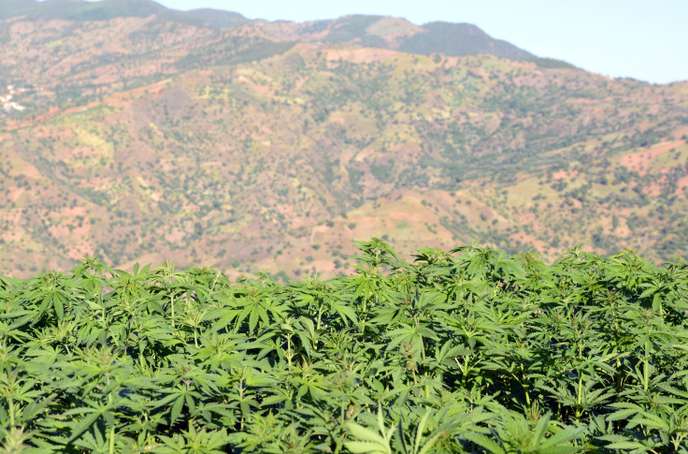
A cannabis field in Issaguen, in the Moroccan Rif, in May 2013. FADEL SENNA / AFP
Nine African countries could soon legalize cannabis. South Africa, Zimbabwe, Lesotho, Nigeria, Morocco, Malawi, Ghana, Eswatini (formerly Swaziland) and Zambia could choose this option by 2023, if one believes the latest report of Prohibition Partners, a think tank that advocates for studies and statistics for a large decriminalization of this drug.
On the continent, Lesotho has been a pioneer, establishing itself as the first to regulate cannabis for medical use in 2008. Ten years later, Zimbabwe followed suit, legalizing its culture, before September in the same year, South Africa allows private consumption between adults.
Read also In South Africa, the patient’s plebiscite the use of the cannabis. The think tank largely stops on the economic potential of such a plant for a continent that already produces 38 000 tonnes per year, without taking advantage of the added value of its marketing. “In no other region of the world, the cannabis industry shows such a contradiction, in terms of the relationship between production and legality,” say the authors of the report, before embarking on costed projections.
Economic advantages
Admittedly, whether for medical or recreational use, there is bound to be potential in this market of 1.2 billion people. A point that does not call into question the executive secretary of the World Commission for Drug Policy, Khalid Tinasti, however doubtful, however, on the 2023 deadline. “It is very difficult to make such forecasts in advance. He says, noting that “regional dynamics have not been taken into account” and that “if there are many national debates, I do not see how this could go so fast”.
The Prohibition Partners report looks at the economic benefits of cannabis for Africa, observing that the plant is more lucrative than many others. For the think tank, the legalization of its trade, by creating an industry, could provide a response to the lack of work to offer to a youth whose importance will increase significantly in the years to come. The experts recall that, developed since the sixteenth century, this culture is relatively adapted to the continent. For Shaun Shelly, a researcher on drug policy at the University of Pretoria, “Cannabis is easily cultivated and requires few nutrients, allowing it to contribute to the economic development of areas with few resources and resources. poor agricultural prospects “.
Read also South African justice legalizes personal cannabis use. In charge of overseeing the report, Alexandra Curley also wants to stress the possibilities offered by medical use. “There are many people in Africa who have TB or HIV that cannabis, which is relatively affordable given its abundance, could potentially help,” says the analyst. She supports her analysis of the weakness of medical systems that remain inaccessible to many, particularly in rural areas. For her, “this substance can represent a therapy ” home”, significantly reducing the dependence on donations of drugs for certain diseases.
Therapeutic virtues
Without recommending its use, the World Health Organization (WHO) recognizes some studies showing that cannabidiol, one of the compounds of cannabis, could have therapeutic virtues. The WHO made a recommendation to this effect in January, suggesting that cannabis be categorized as ” particularly dangerous properties” under the Single Convention on Narcotic Drugs of 1961.
Convinced also of its effectiveness in relieving pain, Khalid Tinasti said that the legalization of medical cannabis requires to adjust certain parameters such as its quality, its shape (plant or pill, for example), or the training of staff on site. A market that Prohibition Partners estimates at 800 million dollars (710 million euros) from 2023, when recreational cannabis would represent, according to the report, a windfall of $ 6.3 billion ($ 5.6 billion euros) for the continent if the nine countries listed legalized their production in the next four years.
Read also Algeria: cannabis shortage in the streets of the capital. The International Narcotics Control Board (INCB), however, has alerted in its report of 2018, the risks of non-medical use of this substance. Shaun Shelly puts this warning into perspective, saying that “cannabis is generally less harmful than alcohol, even if some people with a vulnerability must avoid using it, especially when it contains a high level of THC. [Tetrahydrocannabinol, the main active molecule of cannabis] “Admits, however, the academic.
Cultural barrier
A limit that the authors of the report also take into account, they see in the legalization of this substance a way to control its consumption and therefore avoid drifts.” Studies on the legal markets for recreational cannabis show that the introduction of standardization and regulation of its production is leading to a decline in drug addiction,” says Alexandra Curley. And to cite the examples of Portugal where drug-related deaths have decreased since the decriminalization of cannabis in 2001, and of California where crimes have decreased by 20% since its legalization came into effect on January 1, 2018.
Kenza Afsahi, a sociologist and economist at the University of Bordeaux and the Emile Durkheim Center, agrees, pointing out that “prohibition creates a context of insecurity and violence for users. They are stigmatized, have less information about the qualities they consume and less access to care.” In his eyes, however, regulating this market in Africa will not be easy.
The smoking room, open shoot room for Ivorian outcasts. For Khalid Tinasti, the main obstacle to the legalization of cannabis is played elsewhere than on the economic chessboard. The real barrier, in Africa as elsewhere, remains cultural. First of all, we should start by” getting out of stigma and stop putting cannabis on the same footing as heroin or cocaine”, and for that “to do education, to raise awareness”. However, religious influence contributes to perpetuating a negative image of this substance in the public opinion, which is recalled in the report stressing that “the Catholic Church still considers that the use of cannabis is sin, despite its legalization in several countries like Canada.”
“First develop the African market”
The second point of blockage, according to Khalid Tinasti, is the “weak institutional capacity of many African countries”. He cites the example of his country of origin, Morocco, considered by the Prohibition Partners report as likely to legalize its production of cannabis by 2023. However, “the model of regulation poses a problem, says the researcher, because “if tomorrow, cannabis becomes legal, processing plants will settle around large cities, leaving the mountains of the Rif. For change to be economically beneficial, the interests of farmers must be preserved in Morocco’s main cannabis producing region. “
Read also Morocco: Is the cultivation of cannabis (really) gone up in smoke? The kingdom must also, according to the executive secretary of the World Commission for Drug Policy, accept that its production of cannabis – assuming it actually legalizes it – is destined for the Moroccan market and not for export. “The problem is that African policymakers see their countries as transit areas. Which is completely unrealistic, regrets Khalid Tinasti. The establishment of legalization and the development of this industry will take a lot of time. In the meantime, some countries, such as Canada or Israel, will have come a long way ahead and it will be impossible for African states to catch up. “
More nuanced, Kenza Afsahi also considers it necessary to “first develop the market in African countries, that they benefit also for their people”, without excluding an international development under certain conditions. “In terms of production for export, African cannabis should not become dependent on international market prices or intensive production that drives human exploitation and does not favor small farmers.” , she says. If, according to the report, the African cannabis industry already employs 1.2 million people, their transition to legality should, in contrast to Prohibition Partners’ presupposition, take a little more than four years.