

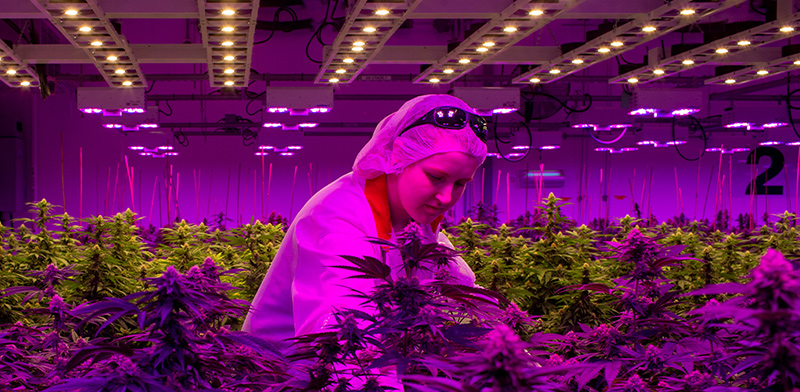
The investment in Cannabis shares has become one of the hottest trends of recent times. What basket funds are responding to investors and where is Israel in this story?
Every few years a new wave hits the capital market and sweeps with investors. From small to small, institutional or private, it doesn’t really matter – we all hear about the wave in the media, see the charts rising sharply and regret that we did not recognize the trend in time. For the most part, it is already too late to join. The chance of getting wet is much higher than the chance of flowing with the wave successfully.
Two decades ago, these were Internet stocks. About a decade ago these were local gas partnerships. Five years ago, it was Biomed shares and two years ago the time came for the Bitcoin and the other virtual currencies, along with many companies riding the cryptographic wave. In the last year, it was the turn of the “green wave” – the shares of cannabis.
It has begun with the legalization of cannabis for free use in the state of Colorado, the first country in the United States to authorize a drug that has been considered by law to be dangerous for years, and since 9 other countries have approved the use of marijuana without prescription, It was already possible to purchase medical marijuana with a prescription.
The companies involved in the field, whether in plant cultivation, processing or marketing to clinics and points of sale, have existed for several years and traded for a long time under the radar investors. These companies, although fully legal, have not been able to get even basic financing from US banks because of the nature of their activity, which has severely limited their growth and profitability, opening up the US market and allowing them to grow and raise money from investors. Whose greatness required legal authorization for their activities.
We will conquer Canada, then the world
In October 2018 Canada officially became a place where marijuana could be legally consumed. The Canadian government has decided that Canadian citizens, many of whom have smoked marijuana illegally before, should do so under strict government supervision and that this product will also bring in additional taxes to the state coffers.
The expectation of this approval boosted the value of many shares on the stock exchange in Toronto during the summer and inflamed investors’ interest in the new wave. This approval also gave legitimacy to the financial industry to open up to this growing industry, especially the basket-fund industry. After all, the growth potential of the industry is very high – it is estimated that the global cannabis market is expected to grow from $ 12.8 billion in 2018 to $ 31 billion in 2022. There are also research institutes that estimate that this market will reach $ 75 billion by 2030 .
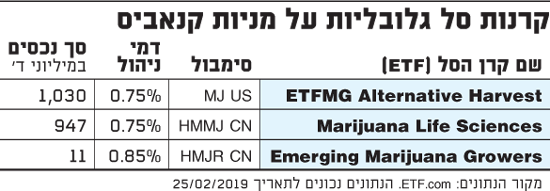
The first ETF launched to meet the growing need for cannabis exposure was born in December 2017, when ETFMG’s LARE fund changed its symbol to MJ and its tracking asset to the Prime Alternative Harvest Index. Before that, the fund followed a real estate index in South America, so the radical change certainly surprised many of the fund’s shareholders at the time.
Since then, no more US ETFs have been launched to track Cannabis shares, but on the Toronto stock exchange two Horizon funds: Marijuana Life Sciences (NYSE: HMMJ) and Emerging Marijuana Growers (HMJR) Cannabis are traded in North America (mainly in Canada but not only).
The increase in the number of countries that approved the legal use of marijuana, together with the surge in cannabis shares on stock exchanges, led to the listing of several other basket funds with a focus on this sector. Currently, there are 3 ETFs waiting for SEC approval to register for trading, but due to the US administration’s suspension, this listing is delayed.
The Israeli angle – InterCure and all the rest
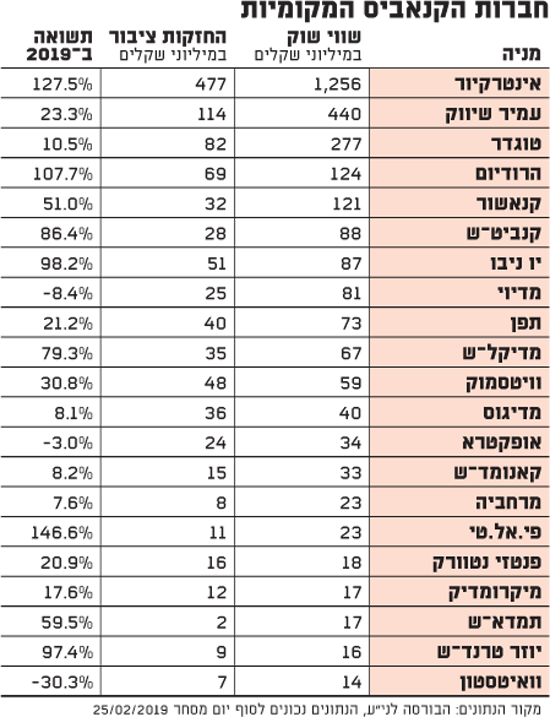
As you know, the local branch of Cannabis has grown in the past year as well. As of this writing, there are 21 local companies with some connection to the field. InterCure is the largest and most recognized of them, and it is also the only one traded on the TASE indices, but it is not the only one.
If we had to launch an Israeli Cannabis share index now, it would probably be made up of the companies listed in the table, with a minimum requirement of NIS 20 million in public holdings.
It should be noted that most of the companies on this list are traded at a very low value, despite a rise of tens and hundreds of percent in their value recently. 5 companies from this list are still on the list of preservation, and all companies on the list are very volatile and not suitable for investment to ordinary investors.
How to be exposed to Cannabis shares?
Along with the great enthusiasm of the indica and sativa aromas on the local stock market, many investors are probably wondering where it all goes. As in any bubble in the past, here too companies seem to grow into an irrational value and crash when the air finally emerges from the bubble. However, unlike other bubbles (such as cryptographic coins), the cannabis industry certainly has a place in the investment world, and it will probably continue to grow for years to come.
This industry is currently at a stage similar to that of the biomed industry in the not-so-distant past. In the end, it is a product that can be used in a variety of medical treatments, beyond being a drug for personal consumption. Demand for the product exists worldwide and will continue to grow, the current profitability is very high compared to other industries (and even compared to the pharmaceutical industry) and therefore it is no surprise that investors are willing to pay quite a bit of money for companies engaged in this field.
But here the resemblance to the pharmaceutical industry is over. The cannabis industry is characterized by very low entry barriers (except for the regulatory barrier). Anyone who wants to do this can buy seeds, plant and grow inflorescences for personal use. This does not require much professional knowledge or advanced degrees, nor even much capital for initial investment. In fact, the most significant investment is required when buying or leasing land for cultivation. It seems that there is no advantage of size in this sector, just as citrus growers, flowers or any other type of agriculture have no advantage over their competitors because of their size.
This leads us to the obvious question: Is it better to try to locate the company that will win the race and be the one controlling the local (or global) cannabis market, or is it better to invest in a basket of companies in the field, knowing that in every growing industry about 30% of the companies will not survive in the end?
The answer to this question is not unequivocal, and it depends on investor preferences. Venture capitalists will choose to tweeze the companies that believe they will survive the bubble and justify their current market value, while more conservative investors who want to get exposure to the industry can do so through one of the existing mutual funds, through traditional mutual funds that track the industry or buy a basket Diffuse of these stocks.